How dice notation works
Dice notation is a short way of writing which dice to roll and what to add. It comes from tabletop games and means the same everywhere.
- d20 (or 1d20) is one twenty-sided die: a number from 1 to 20.
- 2d6 is two six-sided dice added together, 2 to 12. The number before the d is how many dice; the number after it is how many sides.
- 2d6+3 is the same two dice with 3 added to the total, so 5 to 15. The part after the plus or minus is the modifier.
- d100 is a number from 1 to 100, usually read as a percentage chance.
Text roleplay mostly leans on the d20 for "does this work", the d6 for small random effects, and the d100 for percentage chances.
When a roll adds tension
Roll when three things are true at once: the outcome is uncertain, failure would be interesting, and nobody at the table should simply get to decide.
That rules out most of a story. A conversation does not need a roll; the players know what their characters would say. A locked door with nobody around does not need one; failing is boring and the character tries again.
It rules in the moments that matter: sneaking past the guards while the party waits, picking the vault lock while the alarm rings, convincing the duke when he has every reason to refuse. A quick test: if you would be happy writing either the success or the failure, roll. If only one of them, do not roll.
When a roll kills the flow
Dice hurt a text roleplay when they replace writing instead of prompting it. The signs: every action gets a roll, players post bare numbers, arguments break out over what a 13 means, or a scene stalls for a day waiting on a result.
The fixes: roll less, because once per scene is plenty; agree the number to beat before the roll; and treat the roll as the start of the post, not the whole post. The number tells you what happened; you write the rest. Settle this in session zero; our guide to starting a group roleplay covers what else belongs there.
A simple ladder for reading a d20
Use this for any d20 roll where nobody has set a target. It is not a rules system, just a shared way to read the die so everyone sees the same thing in a 13.
| Roll | What it means |
|---|---|
| 1 | Critical failure. It goes wrong and makes things worse. |
| 2 to 5 | Failure with a cost. Something else goes wrong too. |
| 6 to 10 | Failure. It does not work, but nothing else happens. |
| 11 to 15 | Success with a complication. It works, but not cleanly. |
| 16 to 19 | Clean success. |
| 20 | Critical success. It works better than you hoped. |
For a task with a clear difficulty, set a target instead: 10 for routine under pressure, 15 for hard, 20 for nearly impossible. Meet or beat it and it works. Say it before the roll, never after.
Degrees of success
A ladder gives you more than pass or fail. A 12 to sneak past the guards is a success with a complication: you get past, but a guard turns and sees a shadow. A 4 is a failure with a cost: you are spotted, and the whole party has to deal with it.
When you set a target, say what the shades mean. "Beat 15 and you are through clean. 10 to 14 and you are through, but they know someone was here. Under 10 and you are caught." Now every result is a story beat instead of a yes or a no.
Contested rolls
When two player characters want opposite things, neither player should write the outcome. Both roll; the higher result wins, and the size of the gap says how decisively.
Nyx tries to pick Grimjaw's pocket. Nyx rolls a d20 plus a bonus for being quick; Grimjaw, a d20 plus a bonus for being watchful. A gap of one or two is a near thing: Nyx gets the purse, but Grimjaw feels the tug. Ten is a clear win. Decide once how ties resolve, usually for the defender. It is also the fair way to settle a fight between players: nobody concedes, and nobody gets accused of godmodding.
Modifiers
A modifier is the number you add to or take from the die to reflect who is rolling and the situation. Keep it small. On a d20, +2 is a real edge, +5 is a big one, and past +5 the die barely matters.
They come from a strength on the character sheet (a thief sneaking gets +2), a good plan (waiting for the guard change, another +2), or a bad situation (plate armour costs 3). Say the modifier and where it came from before you roll, so nobody argues about it afterwards.
If your group has no system, a house rule that works: +2 when a listed strength applies, minus 2 when a listed flaw does, nothing otherwise. Our OC character sheet guide covers strengths and flaws worth a modifier.
Label every roll
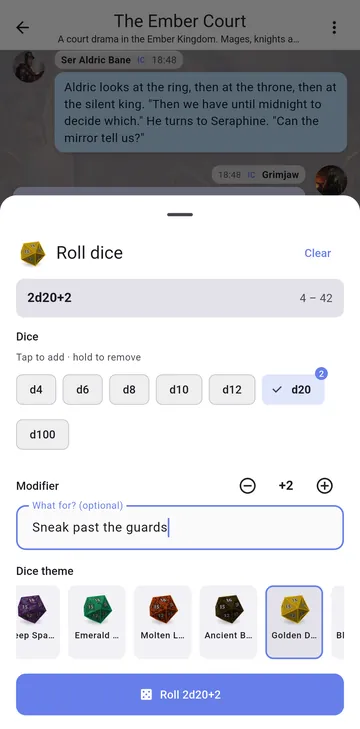
A roll without a label is a number nobody can read back later. Write what it is for, in a few words: "sneak past the guards", "lockpick the vault door", "notice the window".
Labels say what is being decided before the die lands, which ends the "I was rolling for something else" argument. They keep the chat readable as a story. And they make you decide what you are trying to do before you roll. The dice tray in RP Nowz has a field for exactly this, next to the dice and the modifier.
Everyone should see the roll
Rolls only work if everyone trusts them. Rolling a physical die and typing the result is fine between close friends and terrible with strangers; sooner or later someone rolls a 20 too often. Screenshots can be edited and private bot commands rerolled.
Roll where the whole chat can see it, from a source nobody at the table controls. In RP Nowz, rolls are made on the server, not on your phone, and land in the chat for everyone at once, with the notation, each die and the modifier shown. Nobody can quietly reroll.
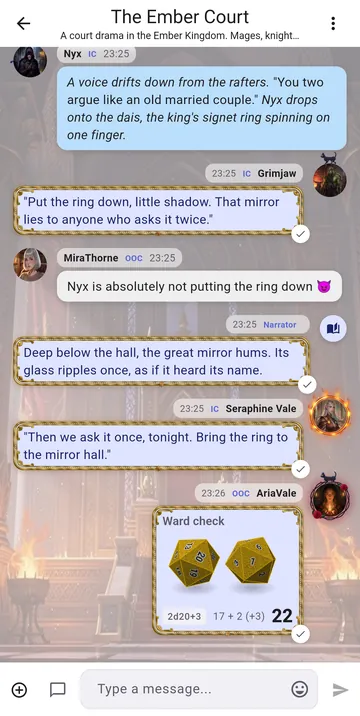
RP Nowz rolls real 3D dice on the server, in the same chat where you write the story. Free on iOS, Android and the web.