Pick a premise everyone wants to play
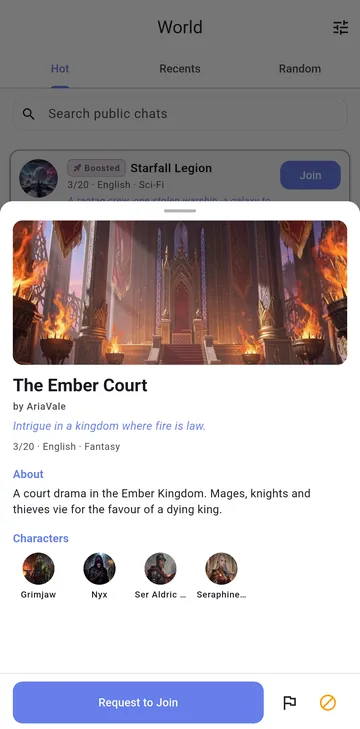
A group roleplay needs a premise before it needs a map or a rulebook: one or two sentences on what the story is about and what the characters will do together. A court drama where mages, knights and thieves compete for the favour of a dying king. A small town where the missing people keep coming back slightly wrong.
Read it to your friends and watch whether they start talking about who they would play. If they ask what the plot is, you have a setting, not a premise, and it needs a problem.
Pick the genre together. Ask each person for two genres they would happily play and one they would rather not, and go where the answers overlap. If the group exists but the idea does not, browse public worlds by genre to see how other tables phrase theirs.
Agree on setting and tone
Setting is where and when. Tone is how it feels to be there. Two groups can share a haunted house and play completely different stories, and one of them is a comedy.
Decide tone out loud. "Grim, and characters can die" is a very different agreement from "dramatic, but nobody dies unless their player wants it". Name a film or a book with the feel you want; one shared reference settles more arguments than a page of rules.
Keep the setting notes to a page: the place, the era, three or four things that make it different from the usual version of its genre, and one open question. Twenty pages of history before the first scene is the most common way a group roleplay never starts.
Make characters together
Build characters in the open, in the group chat. This is not about approval. It is about hooks. When one person says they are playing a disgraced knight, someone else can be the squire who stayed loyal. When two people both want to be the brooding loner, they find out now, not in scene three.
Aim for every character to have at least one tie to another player's character before play starts: a rival, a sibling, an old debt. Our guide to writing an OC character sheet has a template. In RP Nowz a character carries their portrait, backstory, relationships and timeline from chat to chat, so one built for this game is ready for the next.
Hold a session zero
A session zero is a short out-of-character conversation before the first scene, and the one thing that most reliably keeps a group roleplay alive. Cover four things.
Rules. How long is a typical post? Who plays the characters nobody owns? Can a player write the outcome of an action against another player's character, or only the attempt?
Boundaries. Ask each person, privately if they prefer, for anything they do not want in the story, and agree that anyone can say "skip" out of character and the scene moves on.
Posting pace. This is where most groups fail. Agree on a rhythm ("a post a day", "a burst on Sunday evenings") and on what happens when someone cannot keep it. A pace everyone can hit beats an ambitious one every time.
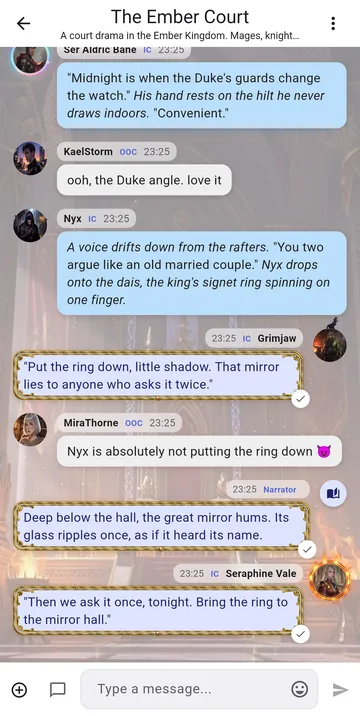
IC and OOC. Decide how you mark in-character and out-of-character talk: brackets or double parentheses in a plain chat app, or a per-message IC, OOC or narrator label in an app built for roleplay, so nobody has to guess whether "I'm going to kill him" is the character or the player.
Decide who narrates
Someone has to describe the world, voice the characters nobody else is playing, and decide what happens when the players act. Three ways to do it:
- One narrator. Simplest and clearest, and a lot of work for one person.
- Rotating narrator. Each chapter gets a different one, which spreads the load and gives everyone a break from their own character.
- No narrator. Whoever introduces a place or a side character writes it. Good for small groups of experienced players, hard for groups still learning each other.
Whichever you choose, give the narrator permission to move things along. A narrator afraid of pushing produces a story where nothing happens.
Open the first scene
Do not open with a lore dump or the weather. Open on a situation every character has to react to: a place the narrator can describe in a paragraph, a reason all the characters are there at once (a hiring hall, a funeral, a ship leaving port), and something that happens which needs an answer. A body is found. The gates close.
Then hand it over. End with a line that gives the scene to the players: "Everyone can hear the bells. What do you do?"
Keep the momentum
Turn order. With three players, free-for-all posting is fine. With five or more, agree a loose order for scenes where everyone is present. The rule that saves the most games: nobody waits for more than two other people. Once two others have posted, you can go.
Recaps. Every few scenes, someone writes three lines out of character: where the characters are, what they know, what is unresolved. It lets a player who missed a week rejoin without rereading two hundred messages. If your app can generate a recap from the chat history, start there.
Side scenes. When the main scene is waiting on one person, two other players can run a short scene of their own: a conversation on the road, a flashback, a letter. They keep people writing without moving the plot past anyone.
Endings. When a scene has answered its question, the narrator says so and cuts to the next. Scenes that drift until everyone stops posting are how a story fades out.
When someone goes quiet
Someone will. Plan for it in session zero so it is not personal when it does. Agree on a waiting time, usually a day or two, after which the scene moves on without the absent character, and let the narrator move them in the background ("Nyx slips out to watch the door") so the story never has to explain a disappearance.
If someone is gone longer, check in privately, once, without pressure. Then decide as a group whether to write the character out for now, hand them to the narrator, or leave a door open.
When dice help
Most text roleplay needs no dice. Conversation and drama are better without them. Dice earn their place when two players want different outcomes and neither should simply decide, or when the group wants a real chance of failure that nobody has to author.
Keep it light: one roll, one clear question ("sneak past the guards"), a number to beat, and a result everyone can see. Our guide to dice in text roleplay covers notation, a simple success ladder and contested rolls. In RP Nowz rolls happen on the server and land in the chat for the whole table.
RP Nowz is free on iOS, Android and the web. Make a chat, invite your friends with a link, and open the first scene tonight.