What a character sheet is for
In tabletop games the sheet holds numbers. In text roleplay it holds decisions you have already made, so you do not have to make them mid-scene. A good OC sheet answers the questions that come up at the keyboard: what would she say here, what does he want from this person, what is she hiding.
The sheet should be short where it does not matter and specific where it does. Nobody needs your character's shoe size. Everyone needs to know what they want.
The template
Copy the fields into a note or your character profile. The right-hand column says what helps at the table, with an example from a court intrigue game. Two or three lines per field is plenty.
| Field | What to write |
|---|---|
| Name | Their full name and what people call them. Seraphine Vale. "Archmage" at court, "the small one" to her oldest friend. |
| Age | A number or a range, and how old they seem. 31, and twenty years younger than anyone else on the council. |
| Pronouns | How they are referred to, and how they want to be addressed. She/her. "Archmage", never "my lady". |
| Appearance | Three details someone would notice first, not a full inventory. Silver hair worn loose, a mage's focus at the collar, a burn scar on the left hand she does not hide. |
| Personality | Three or four traits, at least one of them in tension with another. Measured, curious, quietly ruthless when the crown is threatened. |
| Strengths | Two or three things they are genuinely good at. Ward magic. Reading a room. Waiting. |
| Flaws | Something that makes them choose badly, not a compliment in disguise. Cannot admit she needs help. Holds grudges past the point of sense. |
| Goal | What they want, concretely, and what is in the way. Keep the succession from becoming a civil war, without the council learning how much she is steering it. |
| Fear | What they would do almost anything to avoid. Being seen as the cloister orphan she was. |
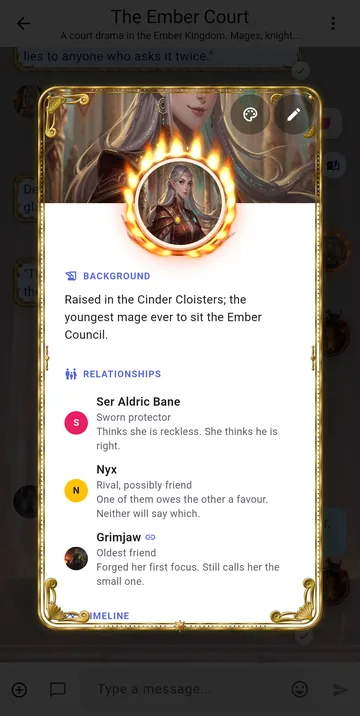
| Backstory | Five sentences at most: where they came from, the turn that made them who they are, and why they are here now. Raised in the Cinder Cloisters; the youngest mage ever to sit the Ember Council. |
| Relationships | One line per connection: who, what they are to each other, and what is unresolved. Ser Aldric Bane, sworn protector. Thinks she is reckless. She thinks he is right. |
| Secrets | What the other characters do not know, and who would be hurt if they found out. She knows exactly how the old archmage died. |
| Voice | How they sound on the page: sentence length, formality, phrases they lean on or never use. Short sentences. Never raises her voice. Uses titles until she trusts you. |
Wants first, then the obstacle
If you only fill in two fields, make them goal and fear. A clear want gives a character something to do in every scene. A clear fear gives the other players something to push on.
Make the goal concrete and slightly out of reach. "Wants respect" is a mood. "Wants a seat on the council before the king dies" is a plan with a clock on it that other characters can help or hinder.
Then put the fear across the path to the goal. The mage who wants the council's trust is afraid of being seen as the orphan she was. Now every scene at court costs her something, and that cost is where the good writing is.
Flaws that cost something
Most flaws on character sheets are compliments in disguise: too loyal, cares too much, a perfectionist. They never cause a problem in play, so they might as well not be there.
A real flaw makes the character choose badly sometimes: something another player could exploit and your character would deny. Jealous of a friend's success. Lies when cornered, even when the truth would be fine. Cannot let a slight go. Pick one or two, and let them cost your character something early, so the group learns they are real.
Strengths matter less, because you will show them anyway. Flaws have to be written down or they quietly disappear. If your group uses dice, both are where modifiers come from; our guide to dice in text roleplay has a house rule for that.
Voice: how they talk
Voice is what makes a character recognisable in a wall of text. Give yourself three or four concrete rules. Short sentences or long? Formal or slangy? Do they use people's names or avoid them? Ask questions or make statements? Any words they lean on, or would never use?
Write a sample line or two, then read it next to another character's. If you cannot tell them apart, sharpen one.
Secrets: what other players should not know
The most interesting things about your character are often things the other characters do not know. Keep them on the sheet, and out of the shared profile.
The rule: other players can know what their characters would know. If your character's secret is that she knows how the old archmage died, the players should find out when their characters do, not from your profile in week one. Tell the narrator so they can build toward the reveal.
In RP Nowz a section of a character profile can be marked as a spoiler: other players see the heading and have to tap to reveal what is under it. It is a courtesy rather than a lock, good for things you want people to discover at their own pace; anything that must stay unknown until the reveal belongs in your own notes.
Relationships are the group's business
Relationships are the field most people leave blank and the one a group roleplay runs on. Write one line per connection to another player's character or an important side character: who, what they are to each other, what is unresolved. "Sworn protector. Thinks she is reckless. She thinks he is right." is enough for a dozen scenes.
Fill this in with the other players, not alone; a relationship is only real if both sheets agree it exists. Our guide to starting a group roleplay covers doing this in session zero.
Let the sheet change
A sheet written before the first scene is a guess. The character you actually play will surprise you by scene five, and the sheet should follow the character, not the reverse.
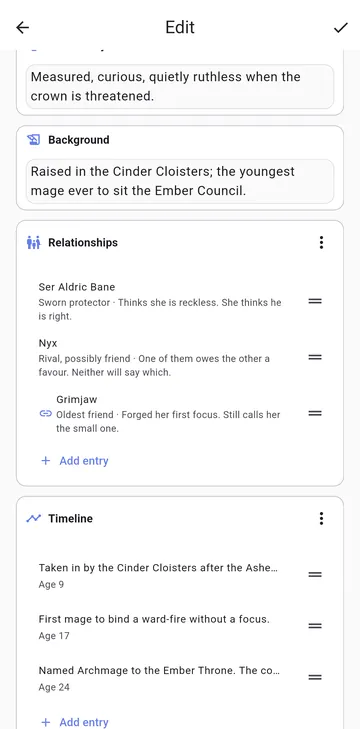
Add a timeline entry when something big happens. Update a relationship when it shifts. Move a secret into the open once it is out. If a flaw you wrote never comes up, replace it with the one that did. Reread it before a scene you are nervous about; that is what it is for.
Characters in RP Nowz carry all of this from chat to chat, portrait, backstory, relationships, timeline, facts and secrets, so the Seraphine who finished one story walks into the next already knowing who she is.
Build your character once in RP Nowz, free on iOS, Android and the web, and bring them into every story you play.